Heading into 2026, the setup for investors was, by most measures, encouraging. Global real GDP was expected to grow by roughly 3.0%, corporate earnings were rising and broadening across sectors and regions, and equity markets—while not inexpensive in the U.S. and select regions globally—were supported by genuine fundamental strength.
Then came the storm.
The conflict involving the U.S., Israel, and Iran has introduced a level of uncertainty that markets have always struggled to price: geopolitics. Energy markets have been unsettled, and what initially looked like a short‑lived disruption is showing signs of becoming more durable. Qatar’s LNG infrastructure, for instance, now faces repair timelines measured in years rather than months. Compounding this is an unresolved global trade war that began in 2025 and has already proven highly disruptive to supply chains that took decades to build.
These are real developments, and we are not in the business of minimizing them. But long‑term investors have seen this movie before—not this exact plot, but the same genre. There is always a wall of worries. Today’s version is no different in character, only in content.
The main actors have changed: AI reshaping labor markets, private credit facing its first real stress test, armed conflict between the U.S., Israel, and Iran with no obvious off‑ramp, and a global trade order being dismantled in real time. Each is worth taking seriously. None of them, individually or together, changes the fundamental case for staying invested.
S&P 500 30‑Year Price Return with ~8.0% annualized trendline
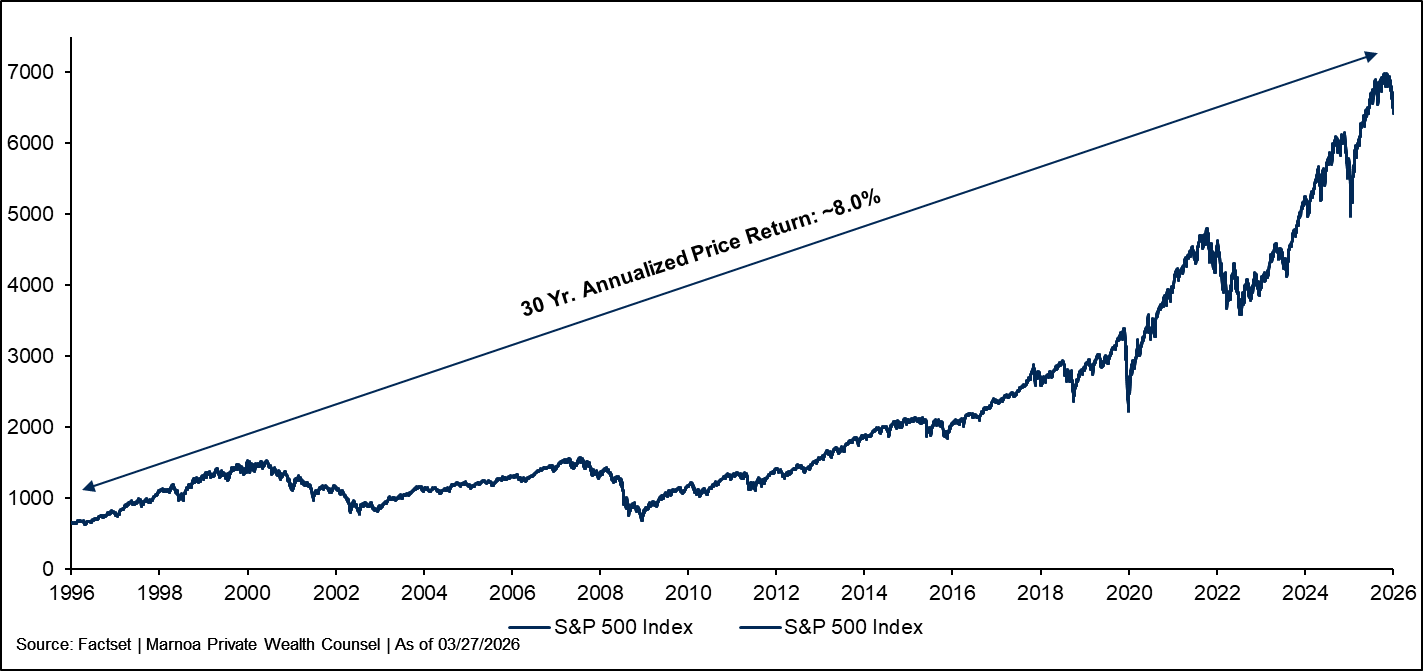
Eight percent annual compounding means an investment roughly doubles every nine years—growing more than ten‑fold over thirty years. The math is straightforward, however, the discipline required to let it work is anything but.
Keep in mind, that this average was achieved through the Dot‑com collapse, a global financial crisis (GFC) that wiped out more than half of the market’s value from peak to trough, a global pandemic, and the most aggressive rate‑hiking cycle in 50 years.
In conversations with clients, we focus on long‑term results rather than returns in any given year. The trap that catches most investors offside is forgetting that those average returns are only available to investors who stay invested through difficult periods. The moment you step aside—shifting unnecessarily into cash while waiting for clarity or for the bottom—you interrupt the compounding process. And in markets, clarity tends to arrive only after the recovery is already well underway.
The Storm Has Always Been There — Only the Names Change
When we overlay the VIX Index—the market’s “fear index”—against the long‑run path of the S&P 500, the picture is striking. Every major spike in fear lines up with a named crisis. Every one of those crises passed. And every time, markets eventually recovered and moved on to new highs.
VIX Index (LHS) overlaid with S&P 500 (RHS), with Major Crisis events
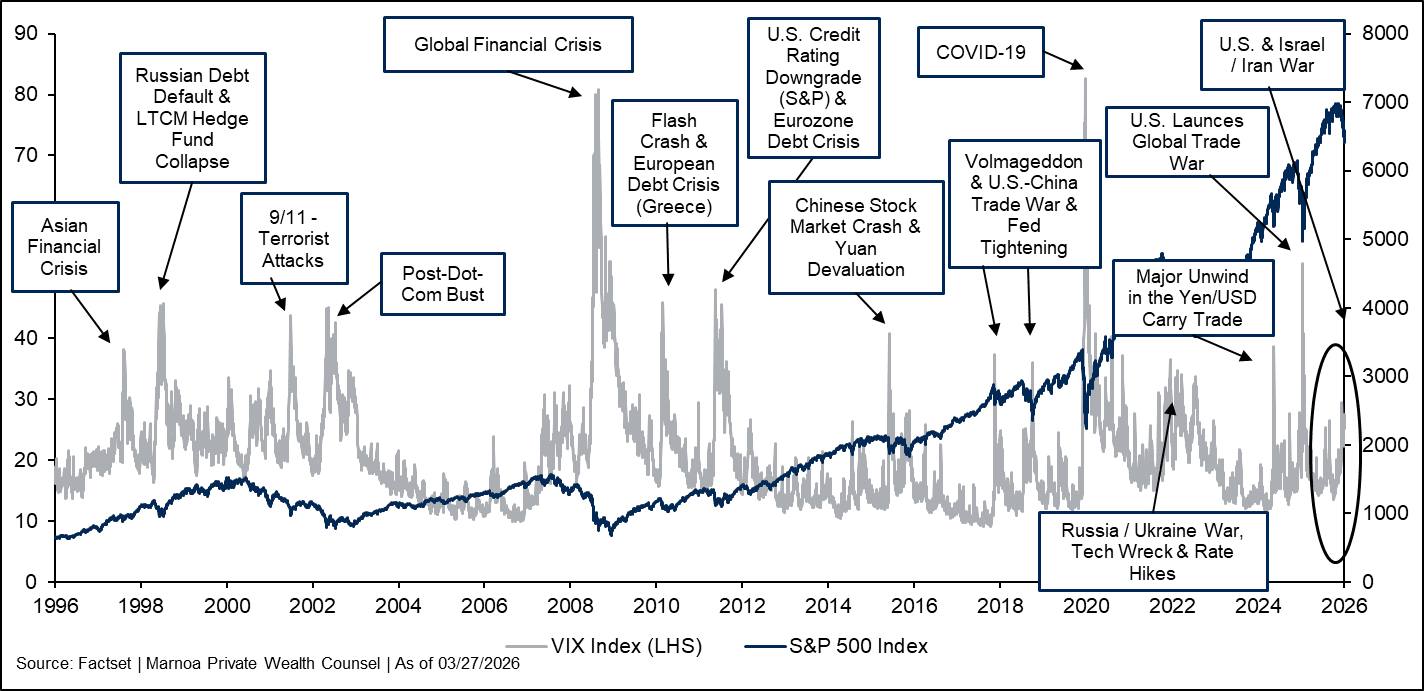
The sequence is familiar: the Asian Financial Crisis; the Russian debt default and near‑collapse of Long‑Term Capital Management (LTCM); 9/11; the Dot‑com bust; the Global Financial Crisis; a U.S. credit rating downgrade; the Eurozone crisis; COVID‑19; the Russian Invasion of Ukraine, and most recently the Global Trade War launched by the President Donald Trump and his administration in 2025.
Each episode felt unique in the moment. Each made staying invested feel irresponsible. And each time, investors who absorbed the volatility and stayed the course were ultimately rewarded.
Don’t Jump Ship When the Waves Are Highest
As I’ve written ad nauseam over the years, missing just the ten best days in the market over a thirty‑year period—out of roughly five thousand trading days—cuts long‑term returns nearly in half. Miss twenty, and a strong result quickly becomes a mediocre one.
Growth of $100,000 — Fully Invested vs. Missing the Best Days over 30 Years
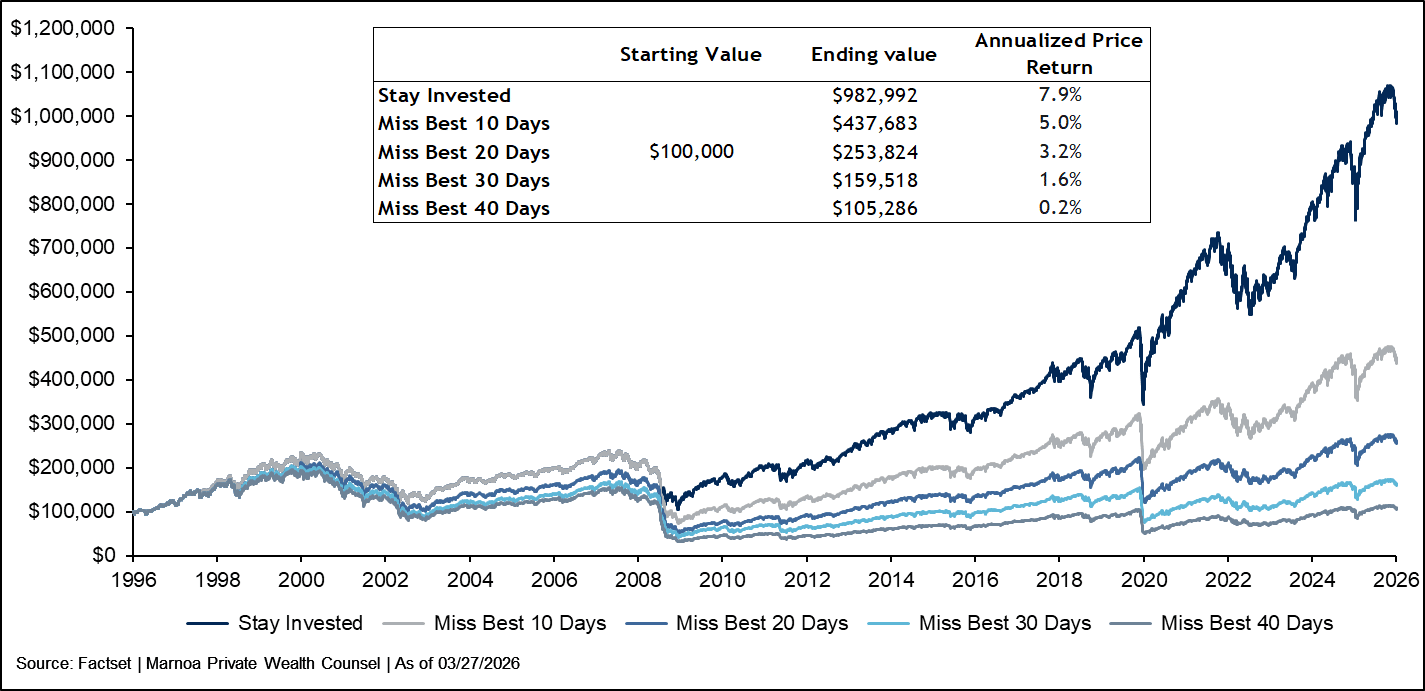
What makes this particularly painful is where those best days tend to occur. They often cluster inside the worst market stretches, when fear is at its peak and the urge to exit is strongest. Many of the largest single‑day gains in history occurred in the middle of bear markets.
This is the real argument against market timing—not that it’s impossible in theory, but that it requires being right twice: once when you sell, and again when you re‑enter. The evidence consistently shows investors doing the opposite—selling into weakness and buying back after strength has already returned.
When the Skies Clear
The wall of worries is always evolving, but the pattern remains remarkably consistent. The businesses that make up the market adapt—cutting costs, adjusting to new realities, and finding ways to grow. For investors with the patience to stay invested, that growth has historically translated into meaningful, compounding wealth.
The current disruptions—the trade war, conflict in the Middle East, questions around private credit, and uncertainty surrounding AI—are not trivial. Some, particularly in energy markets, may take years to fully work through. But they are disruptions, not endpoints.
Markets have a way of making every difficult moment feel like the decisive one—the one that’s finally different. The question is never whether there are reasons to worry. There always are. The question is whether your time horizon is long enough, and your plan resilient enough, to let the storm run its course.
For investors who can hold that line, history has been generous.
At Marnoa Private Wealth Counsel, we build well‑diversified portfolios that begin with an asset allocation framework aligned with each client’s unique risk tolerance and return objectives. This framework guides how we allocate across global equities, bonds, alternatives, and cash. Additionally, we regularly battle test these portfolios to ensure they can withstand exactly this kind of environment.
If the current volatility is raising questions about your plan, please reach out. That conversation is exactly what we are here for.
Sincerely,
Nadeem Kassam, CFA, MBA
Chief Investment Strategist, Chief Operating Officer and Portfolio Manager
Marnoa Private Wealth Counsel
Phone: 519-707-0052
Email: [email protected]
Website: www.marnoa.ca
Connect & follow Nadeem on LinkedIn.