As an adjunct professor of finance at York University, I’m often associated with one familiar answer: “It depends.” It isn’t evasive—it’s an honest reflection of how financial markets work. Reality is rarely as simple as black or white, and 2025 reminded us how quickly the glass can look half full one moment and half empty the next.
For 2026, this analogy still holds.
The answer requires weighing both sides of the glass. As we look ahead to 2026—which is the third year of this new bull market cycle that began in 2022 (the historical average duration of global bull markets since the 1970s is about five years)—we are maintaining a constructive, half-full mindset, aware of the many forces that can tilt the outlook in either direction.
These forces—or risks, including both upside and downside—include a further reacceleration in U.S. growth at a time when inflation is also rising, a continued acceleration in the global shift toward domestic priorities by countries worldwide (e.g., America First, Canada First, etc.), rising political influence over monetary policy (e.g., a more coordinated Fed with the U.S. executive branch), and the possibility of an AI slowdown.
Balancing these risks and opportunities, we believe investors should maintain an overweight allocation to risk assets such as global stocks, a slight underweight allocation to lower-risk assets such as cash and bonds, and a neutral allocation to alternatives. This view is supported by improving corporate fundamentals, more resilient consumer dynamics, ongoing policy support, expectations for easing trade tensions, and manageable inflation across most markets.
Economic Backdrop: Multiple Tailwinds Now Outweigh the Headwinds
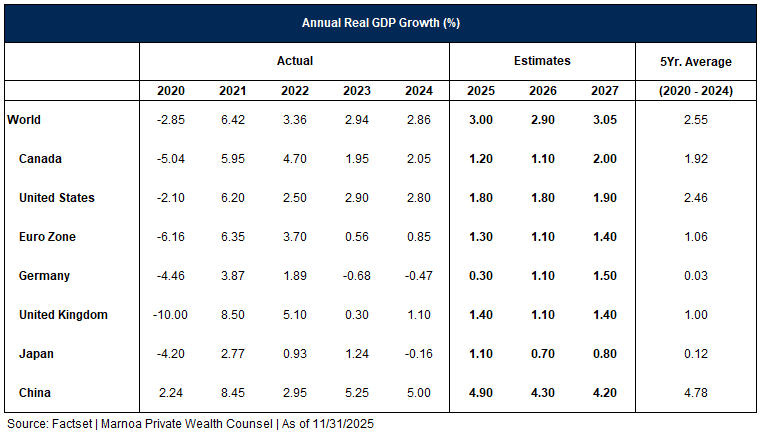
Looking ahead to 2026 and beyond, the global economy is expected to maintain steady, above-trend growth despite ongoing geopolitical tensions and policy uncertainty. Consensus forecasts show world real GDP expanding at approximately 3.0% in 2025, 2.9% in 2026, and 3.1% in 2027—comfortably above the 2020–2024 average of 2.6%. This resilience is underpinned by proactive fiscal support, easing monetary conditions, and surprising consumer resilience across most major economies.
For the United States and Canada, the outlook is particularly constructive. U.S. growth is projected to hold at a robust 1.8–2.0% through 2027, while Canada is expected to accelerate from 1.2% in 2025 to 2.0% in 2027.
Strong corporate fundamentals, ongoing fiscal stimulus, easing monetary conditions, and resilient household spending continue to provide a solid foundation for strong performance from North American equity markets in a fragmented global environment. Further easing in trade tensions will act as a strong catalyst for the global economy, especially for major U.S. trading partners.
Global Growth Remains Resilient in 2025 and Is Poised to Expand Through 2027
Global Equities — A Half-Full Glass with a Firm Foundation
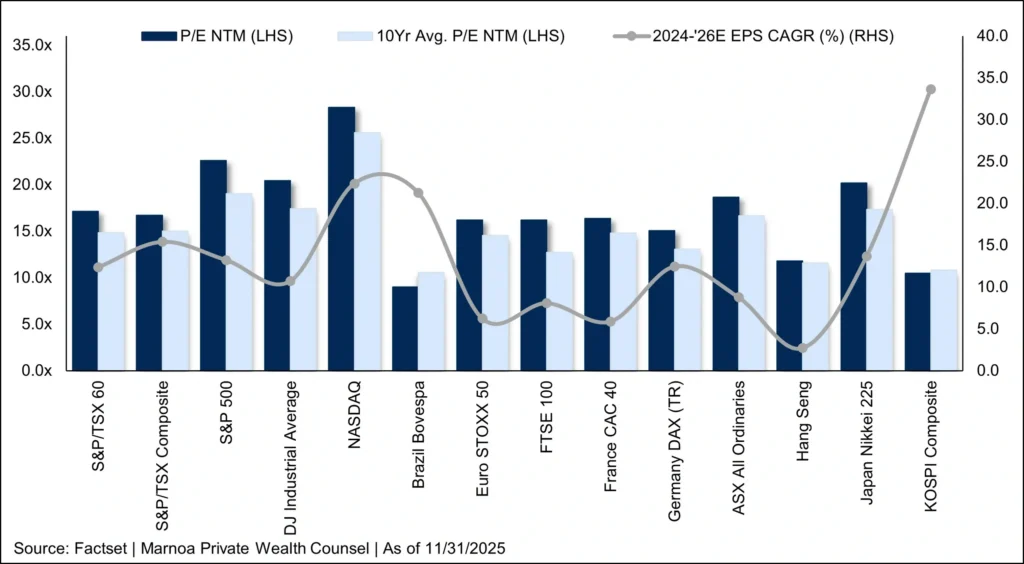
Public equities remain attractive in the U.S., Canada, and several developed international markets. Strong corporate fundamentals, ongoing AI investment and its follow-through effects on the real economy, along with supportive policy, remain key drivers of this positive bias on equities.
While we have observed pockets of excess with elevated valuations and euphoric investor expectations, we would not suggest that this is a broad-based theme. Rather, we are seeing more compelling opportunities in markets globally today than at the start of the year, and we expect to allocate capital across global equity markets heading into 2026.
Valuations and Forward EPS Growth Reveal Opportunities
Fixed Income — Neither Full nor Empty, but Steady
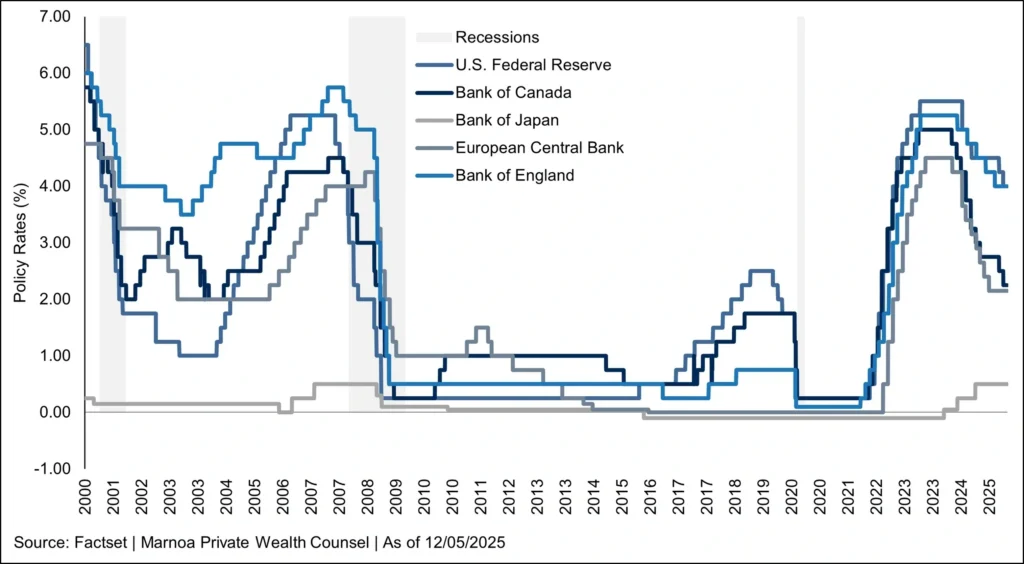
In fixed income, falling overnight rates support short- and mid-term bonds, while heavier government issuance pressures long-term bonds. Corporate issuance has been steady and hasn’t expanded at the same pace as sovereign issuance, which we expect will be supportive for prices and—coupled with higher spreads—offer compelling total returns for investors.
Generally speaking, we believe both public and private fixed income continue to play an essential role in most portfolios—not only for income but also as an attractive total-return vehicle while providing stability during periods of volatility.
Global Rates Fall as Japan Tightens
Alternatives: Seeing the Glass Half Full
In alternatives—including private equity, private credit, real estate, hedge funds, and commodities—we continue to find attractive opportunities, with top-tier managers consistently generating returns that outperform public-market equivalents after fees. Our flexibility to allocate across both public and private markets allows us to capture the most compelling risk-adjusted returns available for any given exposure.
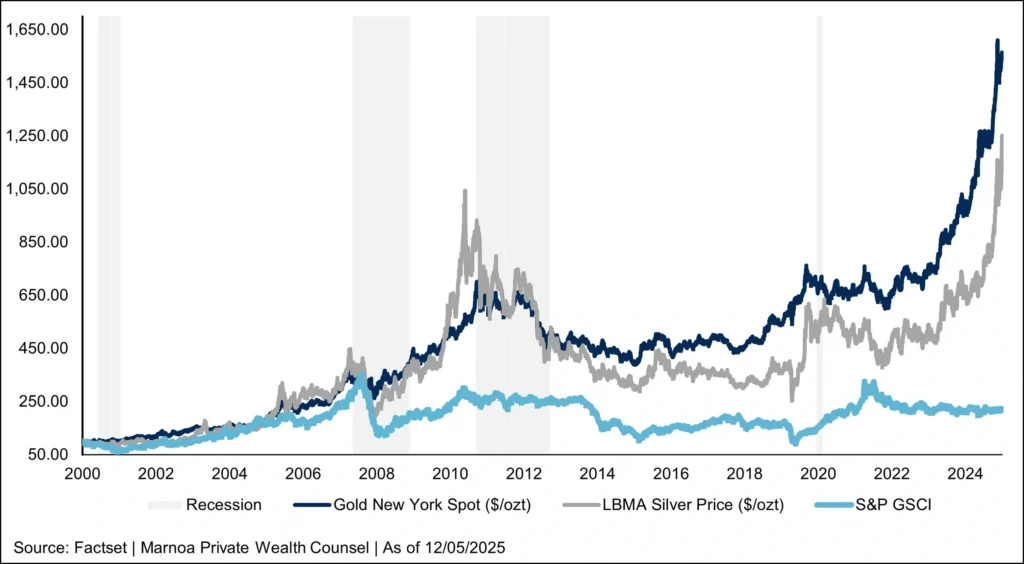
With gold and silver having shone brightly in 2025, it’s worth mentioning our take entering 2026: we continue to regard precious metals as a highly attractive strategic allocation in today’s environment. Our long-standing conviction is that they serve primarily as a robust store of value and deserve a permanent portfolio position rather than being treated as a short-term tactical trade.
This view feels especially relevant now, given elevated fiscal deficits, rising global debt, persistent monetary expansion, and ongoing questions about long-term currency purchasing power—factors that should keep real yields low and provide lasting support for both gold and silver.
Precious Metals Shine in 2025, Supporting Strategic Allocation
Our overall view for 2026 remains constructively positive. While we expect new risks to emerge that will add to and rattle markets and investor confidence, we plan to be ready to deploy capital at times when investor emotion takes over, forcing them to sell great investments at the worst possible moment (e.g., selling low, buying high).
Finally, we want to extend our warmest wishes to you and your loved ones for a joyful holiday season and a happy, healthy 2026 ahead. Thank you for the trust you place in us as your wealth partner. We never take it for granted and remain genuinely grateful for the opportunity to serve you and your family.
As always, please reach out anytime—we’re here for you. If you haven’t already, Subscribe to receive these regular updates straight to your inbox.
Sincerely,
Nadeem Kassam, CFA, MBA

Chief Investment Strategist, Chief Operating Officer and Portfolio Manager
Marnoa Private Wealth Counsel
Phone: 519-707-0048
Email: [email protected]
Website: www.marnoa.ca
Connect & follow Nadeem on LinkedIn.