The U.S. District Court issued a ruling last week in the Department of Justice (DOJ) antitrust case against Google. The court recognized that Google held monopoly power in online search and search text advertising markets.
The court rejected the most severe structural remedies including forcing Google to divest the Chrome browser or the Android operating system. The ruling preserved Google’s integrated ecosystem and maintained its distribution payment arrangements with partners like Apple. Industry analysts view this as the best-case scenario, removing regulatory overhang without altering Google”‘s core business.
The ruling explicitly recognized artificial intelligence’s (AI) disruptive potential in reshaping the online search market. The rise of generative AI tools have changed the competitive landscape since this case began in 2020. The court noted noted that the rise of generative AI–driven by companies like Anthropic, OpenAI, Meta, and Microsoft–has made the AI space highly competitive, diminishing Google”‘s distinct advantage. These factors influenced the court”‘s decision to prefer behavioral remedies focused on data-sharing with competitors over structural breakups of Chrome or Android.
Background and Ruling Details
The U.S. Department of Justice filed the antitrust lawsuit in October 2020.
The DOJ alleged that Google maintained illegal monopolies in general search and search text advertising. Google achieved this through exclusive contracts and distribution deals with device manufacturers, web browsers, and mobile carriers. Most notably, the long-term agreement with Apple that sets Google as the default search engine on Safari.
The U.S. court”‘s ruling addresses these concerns through targeted behavioral remedies. The main points of the remedy ruling include:
1. Google barred from entering exclusive distribution deals, but may continue making payments to Apple to preload Google Search on Apple devices
The ruling prohibits Google from exclusive distribution deals for Search, Chrome, Google Assistant, and its generative AI products (Gemini) with partners such as Apple on any device. This means Google cannot lock partners into exclusivity deals for these services.
However, the ruling allows Google to make payments or offer other incentives to distribution partners for preloading or placing Google Search, Chrome, and its generative AI products. This includes the arrangement with Apple, where Google is allowed to continue paying an estimated $20 billion annually to keep Google Search as the default search engine on Safari for Apple devices. But these revenue-sharing arrangements cannot be exclusive. Google cannot enter into exclusive contracts that restrict the adoption of competing search engines. The ruling restricts search placement deals to no more than one year. The ruling opens the door for competitors to outbid Google each year.
Shifting negotiations from a multi”‘year deal to an annual cycle means Apple has the flexibility to renew or renegotiate the terms of its revenue”‘sharing agreement each year, which could be perceived as a positive takeaway for Apple in this ruling.
That said, with the shift to annual resets, Google”‘s Traffic Acquisition Costs (TAC) could experience greater volatility than previous years. TAC remains a critical element of Google”‘s expense structure. While the company can continue making distribution payments, restricting contracts to one-year terms introduces added uncertainty. The annual renewal cycle enhances negotiating leverage for partners like Apple. This could pressure Google”‘s margins and increase variability in costs and cash flow over time.
Apple’s enhanced negotiating position may enable the company to secure higher revenue-sharing percentages. It also allows Apple to explore alternative partnerships with emerging competitors, such as Perplexity AI. These competitors have AI-enabled search engines that could potentially become Apple”‘s default search option in the future.
We anticipate Google Search could face shifts in query volume as users transition from traditional search interfaces toward conversational AI platforms. According to Evercore ISI recent survey data, Google remains the clear leader in Search, but its share has slipped to 70% in August 2025, down from 71% in May 2025 and 80% in June 2024. Meanwhile, ChatGPT rose from just 1% in June 2024 to 13% in August 2025, with adoption strongest among Gen Z (18–29-year-olds) and Millennials (30–44-year-olds). However, Google”‘s dominance in commercial searches (e.g., where can I buy tickets for the next Toronto Blue Jays game?) like shopping, travel, and financial services remains stable, suggesting its losses are concentrated in general information queries.
For a deeper look at Google”‘s competitive landscape and AI strategies, please refer to my previous article titled “Alphabet: Defending Google”‘s Search Leadership in the AI Era.“
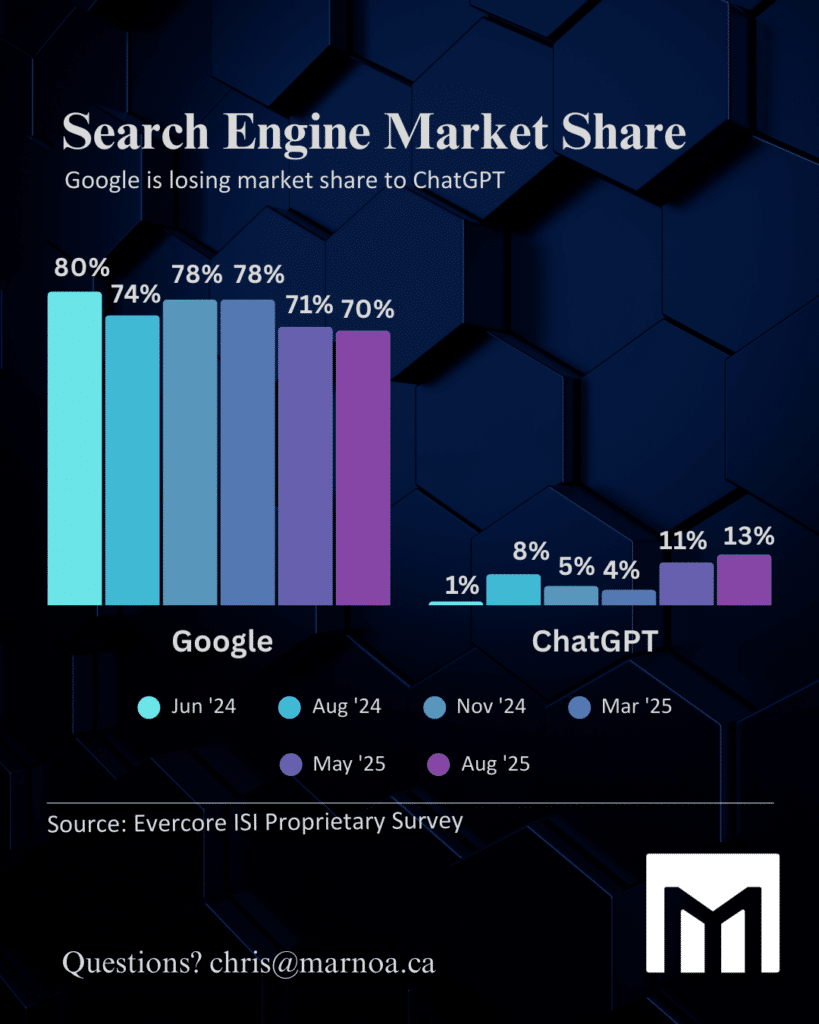
Source: Evercore ISI. September 7, 2025. Alphabet Inc.
2. Google will not be forced to sell Chrome or Android
The U.S. court will require Google to divest or structurally separate its core assets, specifically the Chrome browser and the Android operating system. This decision represents a significant win for Google. It allows Google to maintain its valuable integrated product ecosystem. The ruling helps ensure the continuity of Google’s connected products, reinforces user lock-in, and supports its scale advantages in search and advertising. This outcome avoids a potential disruption that might have accelerated traffic and market share losses in search if Chrome or Android had been separated from Google”‘s core services.
3. Google is required to share certain data to qualified competitors
The court imposed targeted data sharing obligations. Google must share search index and user interaction data with qualified competitors under specific limitations. This remedy addresses monopolistic concerns while establishing protective boundaries that prevent competitors from completely replicating Google’s search capabilities without substantial investment in their own technology infrastructure.
Google must offer search syndication services that allow rival search engines to license Google’s results and features for distribution on their own platforms. The court structured this obligation with declining query volume caps designed to encourage competitor independence over time.
Competitors can access 40% of Google’s annual search queries in the first year, with the cap decreasing annually in equal increments over five years (i.e., a 40% cap in year one, a 32% cap in year two, a 24% cap in year three, etc.). Evidence showing that competitors can develop search technologies capable of answering 80% of user search queriers independently informed the court”‘s decision on mandating these caps.
The data syndication requirements give competitors access to two critical data categories that form the foundation of Google’s search dominance. First, competitors gain access to Google’s search index, which contains the ranking algorithms and information architecture Google uses to deliver relevant search results. Second, competitors gain access to Google”‘s user interaction data that shows how users engage with Google’s services, including click patterns, search refinements, and behavioral signals that guide result quality.
The intent behind these obligations centers on preventing Google from leveraging its dominant market position to eliminate competitive threats through data advantages alone. The court recognized that search market competition requires access to massive data sets and sophisticated ranking algorithms that create insurmountable barriers for new entrants. By mandating controlled access to Google’s proprietary data infrastructure, the ruling lets qualified competitors develop viable alternative search engines without starting data collection from scratch.
We believe the long-term competitive implications could raise risks to Google’s market dominance, particularly regarding high-value distribution partnerships like its arrangement with Apple. Enhanced access to Google’s search data and user interaction patterns enables competitors to rapidly improve their search quality and relevance, potentially creating viable alternatives for default search partnerships. Apple and other major distribution partners could leverage improved competitor capabilities to negotiate better terms with Google or switch to alternative search providers that offer superior revenue sharing or innovative features powered by Google-derived insights.
This data syndication mandate represents a calculated regulatory approach that promotes competition while preserving Google’s incentive to continue investing in search technology innovation. But we recognize that it weakens the data moat that previously protected Google from meaningful competition, creating ongoing pressure on market share and pricing power in distribution negotiations.
Final Remarks
The court ruling establishes a six-year oversight period that reshapes Google”‘s competitive landscape through targeted behavioral remedies. While the outcome was more favorable than anticipated, several risks remain: 1) higher cost volatility and margin pressure from annual Apple deal renewals, 2) potential erosion of Google”‘s data advantage as rivals gain access to search and user interaction data, and 3) intensifying competition from AI-enabled challengers that could disrupt default search partnerships.
Importantly, the absence of structural remedies–such as a forced divestiture of Chrome or Android–preserves Google”‘s integrated ecosystem, preventing a fundamental shift in its business model. Retaining control of these assets, alongside continued flexibility to make distribution payments, ensures Google maintains scale advantages and user lock-in that underpin search dominance.
With regulatory uncertainty meaningfully reduced, investor focus is likely to pivot back toward long-term growth drivers. These include accelerating AI integration across core search products, monetization opportunities in YouTube through both advertising and subscription models, and the ongoing expansion of Google Cloud.
Nonetheless, Alphabet is expected to appeal the syndication obligations, which grant competitors access to critical datasets. While near-term operational disruption is limited, the medium-term risk profile has shifted. Competitors now have a clearer pathway to improve search quality and challenge distribution deals.
Later this month, Google will face another major trial focused on its digital advertising business. The U.S. District Court previously ruled that Google engaged in illegal monopolistic practices in digital advertising technology in the publisher ad and ad exchange markets. The U.S. Justice Department and multiple states are seeking Google to divest parts of its ad technology and make its auction algorithm open source.
Our team will continue to monitor the court cases and reflect on the increased competitive pressure against the durability of Google’s ecosystem advantages.
P.S. If you missed my previous letter, read it here: https://marnoa.ca/volatility-friend-or-foe-redefining-investment-risk/
Christopher De Sousa, CIM®
Portfolio Manager
(519) 707-0053
marnoa.ca