If I had to describe this year’s market behavior in a single term, it would be “volatility.” The primary source of this volatility has been the U.S. administration’s evolving trade policy. The abrupt implementation of broad, country-specific tariffs created a regime shift in market expectations, introducing policy risk at a scale the market had not priced in. Unfortunately, it is not done yet!
Equity and credit markets absorbed rising uncertainty through late Q1, but volatility intensified in Q2. The inflection point occurred on April 2, 2025 (dubbed “Liberation Day”), when the U.S. administration announced new tariffs on strategic trading partners at magnitudes that materially exceeded consensus assumptions. Market participants quickly anticipated potential inflationary pressures, slower growth trajectories, and the possibility of retaliatory trade measures. The result was accelerated repricing in both equity multiples and sovereign yield curves.
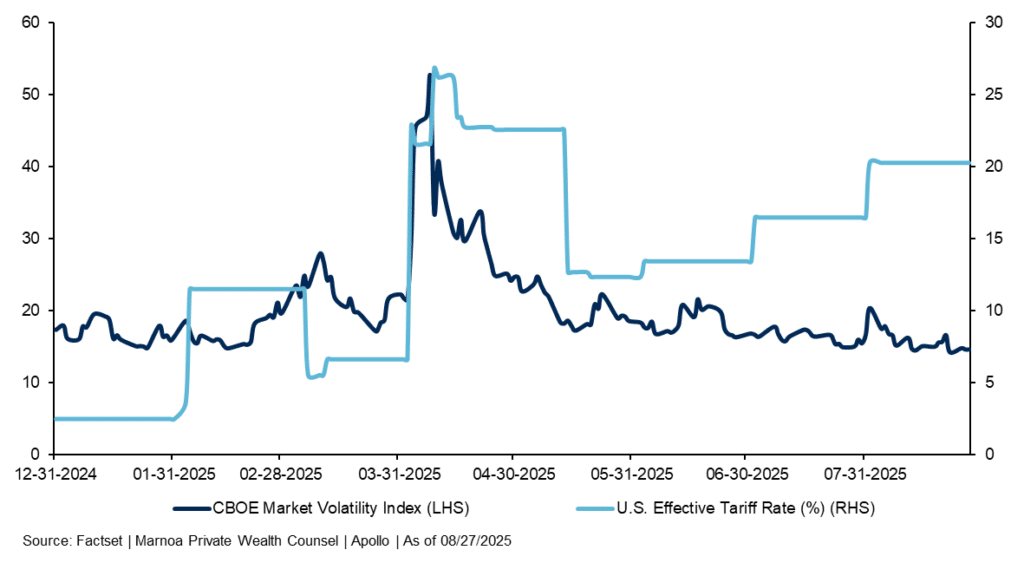
As depicted in the chart below, the volatility of U.S. stocks—as measured by the CBOE Market Volatility Index (VIX)—has exhibited a strong correlation with fluctuations in U.S. effective tariff rates on imports. For this analysis, we have used the S&P 500 as a proxy for global equities, given its broad representation and the fact that global equity markets have exhibited similar levels of volatility in 2025.
While the VIX index has fallen sharply from its April peak, based on current trends, we expect this volatility to pick up again in the coming months.
Click here to read our Market Outlook: Mastering the Playground of Markets in H2 2025.
U.S. Stock Market Volatility (VIX) vs. U.S. Effective Tariff Rates (H1 2025)
How We Think About Volatility and Risk
Retail investors often equate volatility with risk. This view is reinforced by measures such as beta and standard deviation that attempt to quantify risk. Under that framework, any deviation from average returns implies increased uncertainty and, by extension, greater risk exposure.
Beta measures an asset’s volatility relative to the overall market. It quantifies how sensitive the asset’s returns are to movements in the market. Beta specifically reflects the asset’s systematic risk or market-related risk—the portion of risk that cannot be diversified away and that contributes to the risk of a market portfolio.
Standard deviation measures the total volatility of returns around the average return and captures the amount of deviation regardless of its direction. It treats upside (positive), and downside (negative) moves equally without distinguishing between them. This means it does not separate favorable movements from unfavorable ones but rather measures overall variability around the mean return.
These metrics have limitations.
Beta focuses only on market (systematic) risk. Standard deviation treats all volatility equally regardless of direction. Deviations from average returns do not strictly imply increased uncertainty and risk exposure.
Using volatility as a gauge for risk is incomplete.
Volatility measures the fluctuation in market prices—NOT the risk of permanent capital impairment and loss.
As illustrated in the chart below, the S&P 500 Index has achieved an average annualized total return of approximately 8%, but this performance has been accompanied by recurring calendar year drawdowns, reflecting periodic declines from peak to trough.
S&P 500 Index: Annual Price Returns and Maximum Calendar Year Drawdowns (2000–2025)
Risk is not a simple measure of the temporary swings in the market.
A stock that falls 15% because of market noise is volatile, but not necessarily risky if the underlying business remains strong and its long-term value is intact. By contrast, a company with deteriorating fundamentals may pose genuine risk even if its stock price appears stable.
Investment risk lies in the potential for assets to lose enduring economic value, whether through deteriorating business fundamentals, poor capital allocation, or structural industry shifts.
We define true investment risk as the permanent loss of capital. Market volatility may signal uncertainty, but it is not—on its own—a measure of risk.
Why Volatility Can Be Your Good Friend
Investors instinctively treat volatility as a warning sign. Sharp swings feel unsettling, and the natural response is to step back. But volatility plays a vital role in the market’s way of answering the fundamental question: “What is this asset really worth?”
Price discovery unfolds through continuous interaction among buyers and sellers as they interpret evolving data, such as corporate earnings, macroeconomic trends, policy changes, and liquidity conditions. These interactions create price swings that may look chaotic, but they signal that the market is functioning as intended—absorbing latest information, resetting expectations, and finding fair value. The market constantly revalues capital in real time to reflect the most up-to-date understanding of risks and opportunities.
Fear and short-term thinking often push prices far below the true intrinsic value of great businesses. When that happens, long-term investors get a chance to buy quality assets at meaningful discounts. These entry points appear most often in volatile markets, not calm ones. Instead of viewing volatility as something to avoid, think of it as a tool. For disciplined investors who can tolerate short-term fluctuations and stay focused on fundamentals, volatility creates opportunities to buy great businesses at favorable prices.
Volatility should not be viewed as your enemy. Volatility can be your good friend if you have a long-term outlook and the goal to compound wealth over time.
Focusing on Businesses, Not Market Noise
The challenge in investing is not predicting where the market will go next month. No one can reliably do that. Instead, it is identifying great companies at fair or discounted prices. That requires deep knowledge of a company’s products and services, its competitive advantages, its ability to grow earnings and cash flows, and the quality of its management team. Our focus rests squarely on whether a business can compound intrinsic value over time rather than thinking in terms of weeks or quarters.
Investors who orient decisions around the next few weeks, months, or even days, often become overly exposed to market noise. This noise includes daily price fluctuations, sensational headlines, and social media trends that can cause emotional and impulsive decision-making. This behavioral bias leads to reactionary positioning—buying into strength and selling into weakness. This can lead to capital destruction, in our experience.
In contrast, our process minimizes the role of near-term fluctuations and emphasizes the drivers of long-term value creation. These include earnings power, free cash flow generation, and strong returns on invested capital. We also focus on the durability of a company’s competitive advantage.
Markets can behave irrationally in the short run, but not forever. Over time, strong businesses see their true value reflected in their stock price. That is why our approach is grounded in patience, discipline, and business analysis rather than timing or forecasts. We focus on where a company’s earnings and cash flows will be in the next five years and beyond—not where the stock trades tomorrow.
Final Remarks
Volatility is not a threat to avoid; it is a tool to use. It can come from headlines, policy shifts, or changing sentiment. Market turbulence often opens the door to buying quality assets at meaningful discounts. That is where opportunity lives. Discounted assets created by volatility often present entry points to invest at lower prices. These purchases at a discount can form the foundation for stronger returns over time as the market recovers and asset values grow.
We continue to deploy capital selectively into opportunities. We stay focused on investing in high-quality, competitively advantaged businesses exposed to secular growth trends and expanding addressable markets. We continuously refine our portfolio and are always asking how to improve its quality, manage risk, and enhance long-term returns.
Our investment objective remains the same: preserve and protect capital while compounding it steadily over time.
P.S. If you missed my previous letter, read it here: Beyond the Hype: The Growth Opportunity in Artificial Intelligence
Christopher De Sousa, CIM®
Portfolio Manager
(519) 707-0053
marnoa.ca