On July 4, 2025, the United States celebrated its 249th anniversary of independence from British rule—a milestone that ushered in a festive long weekend of joy, celebration, and fireworks for many of our valued clients, friends, and colleagues. For my family, it was an especially joyful occasion, as my son and I both blew out birthday candles on July 4th and 5th, respectively.
At the playground, I watched my children, and their friends ride the seesaw, their animated laughter echoing as they soared with unrestrained enthusiasm one moment, then gripped the handles with determination to restore balance the next. This vibrant scene mirrors the financial markets in the first half of 2025. Like the seesaw’s rhythmic rise and fall, the markets have swung between exhilarating highs and cautious lows, demanding that investors maintain foresight, a disciplined strategy, and unwavering resolve to navigate effectively.
Similarly, investor sentiment reflects this playground dynamic. While some economies enjoy resilient corporate earnings and robust growth, these are tempered by renewed inflation expectations, heightened geopolitical uncertainties, trade policy fluctuations, and an uncertain interest rate outlook. Success in this environment hinges not on remaining static but on mastering the cadence of the market’s swings to capture opportunities while mitigating risks.
As we look to the second half of 2025, our mission is to navigate this dynamic market playground with precision and agility, strategically positioning our client portfolios to withstand volatility while seizing opportunities (e.g., buy-low/sell-high).
First Half 2025: Swinging on the Tariff Seesaw
The first half of 2025 was a playground of volatility, driven by U.S. policy shifts under the administration of President Donald J. Trump. Aggressive tariff announcements, followed by abrupt reversals—playfully dubbed “TACO” (Trump Always Chickens Out)—sent markets on a wild ride, sparking economic uncertainty and sharp fluctuations. These policy swings fueled significant volatility, much like my children pushing a seesaw to its limits, testing both market stability and investor nerves.
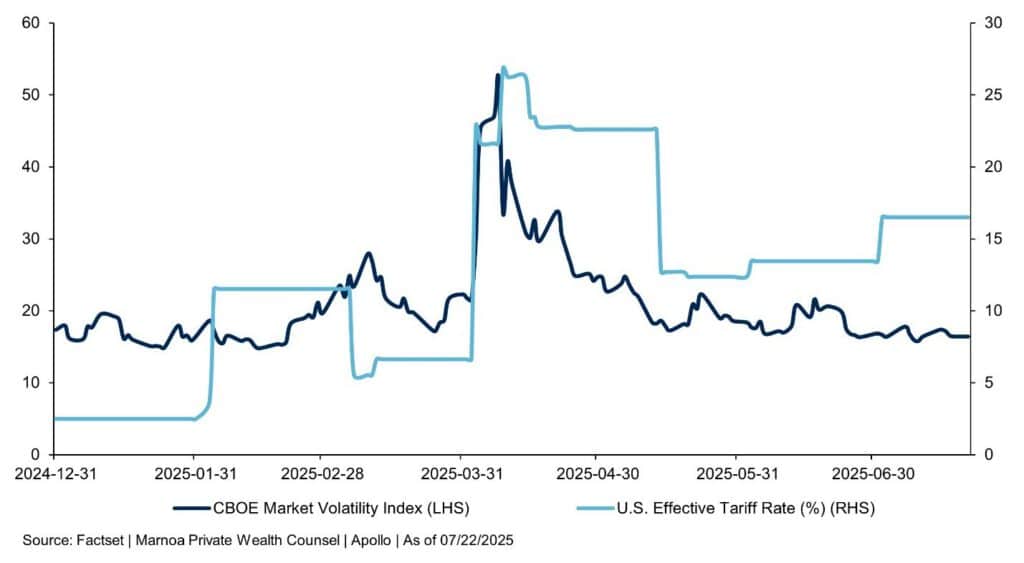
As shown in the chart below, the volatility of U.S. stocks, as measured by the CBOE Market Volatility Index (VIX), has been closely correlated with changes in U.S. effective tariff rates on imports. We expect ongoing uncertainty to remain a key driver of volatility in the months ahead.
U.S. Stock Market Volatility (VIX) vs. U.S. Effective Tariff Rates (H1 2025)
Of note, these unpredictable swings have tested investor confidence, much like my four-year-old learning to steady the seesaw, raising questions about the U.S. dollar’s long-term reserve status and the reliability of the U.S. as an ally and trading partner. Consequently, investors are increasingly diversifying away from U.S. assets—equities, bonds, and the U.S. dollar—toward international markets, a trend we expect to persist. Despite strong U.S. fundamentals, non-U.S. markets have outperformed, like children racing to the top of the playground slide.
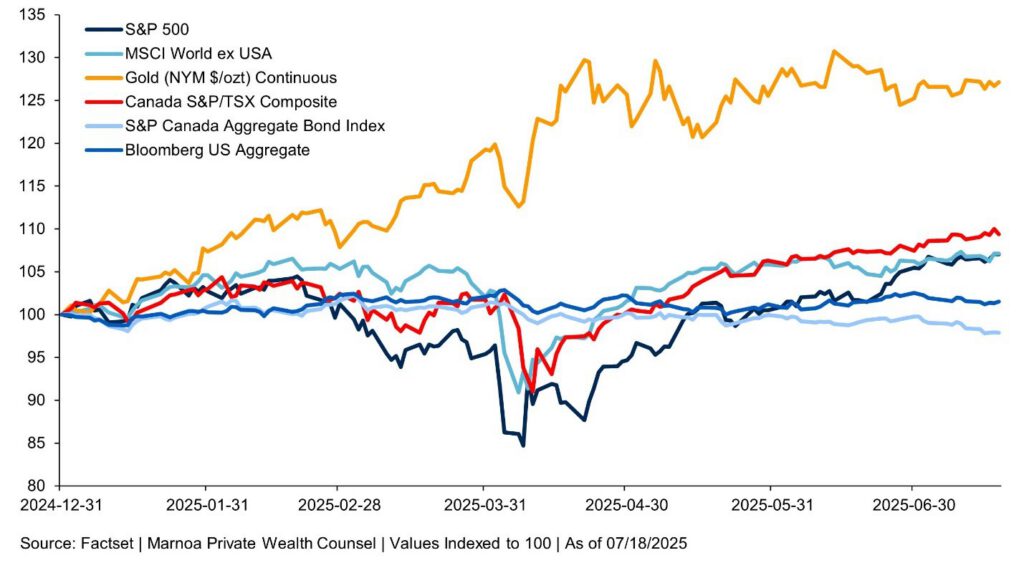
As shown in the chart below, while U.S. markets have posted positive year-to-date returns, global markets have outperformed. Across asset classes, gold has emerged as one of the top performers this year, underscoring the value of diversification. We expect this trend to continue but remain opportunistic in seeking opportunities both in the U.S. and abroad.
Select Asset Class Performance (H1 2025)
Looking ahead, a key focus for investors is the upcoming tariff deadline. On August 1, 2025, certain U.S. tariff rates will expire, and new reciprocal rates will take effect, as confirmed by President Trump’s Executive Order on July 7, 2025.
Second Half 2025 Outlook: Playing Smart on the Market Playground
The market’s initial reaction to the April 2025 Liberation Day Tariff announcement was a sharp slide, as investors sold U.S. assets and shifted capital to international markets and global asset classes. However, resilient U.S. fundamentals—strong corporate earnings, consumer spending, and economic growth—have been tempered by ongoing uncertainty on trade, geopolitical, and policy fronts, which may begin to appear in economic and corporate data in H2 2025.
For our clients, our strategy remains focused on balancing risk and reward while deploying capital during periods of market dislocations. Should volatility surge, our clients can expect us to act prudently and deploy capital opportunistically as compelling risk/reward opportunities arise.
Equity Positioning: Up the Slide, Not Down It
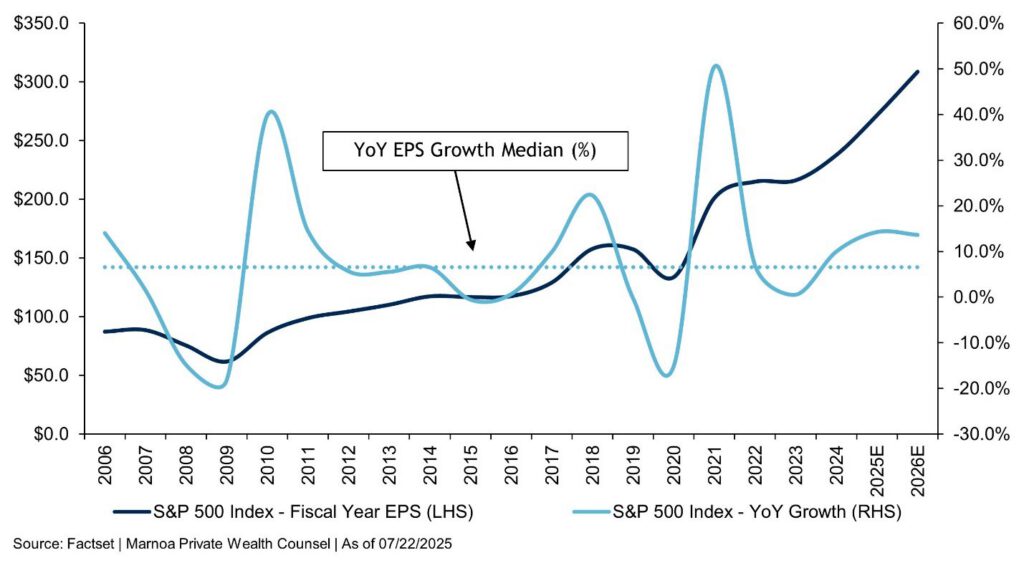
Large-cap U.S. company earnings (i.e., S&P 500 Index) have remained robust this year, with current projections forecasting 9–10% earnings growth in 2025 as we progress through the Q2 2025 earnings season. Barring major disruptions, U.S. equities are positioned to reach new highs, supported by strong Tech/AI fundamentals, over $7 trillion parked in global money market funds, and retail investors buying into weakness. That said, caution is warranted for H2 2025, as stretched valuations and slowing growth could lead to concentrated market leadership, echoing trends seen in 2023–2024.
U.S. Earnings Durability + Growth = Price Resilience
Equities across developed markets in Canada, Europe, the UK, and Japan are outpacing the U.S. in year-to-date performance. We believe the shift toward global diversification is still in its early phase, despite concerns of overcrowding, with U.S. stocks still near peak weights in global portfolios after over a decade of outperformance. We expect continued strength in international markets—especially domestic-focused companies—supported by a weaker U.S. dollar. For our clients, we maintain balanced exposure across U.S. and global equities, blending high-growth Tech/AI themes with resilient, high-quality global opportunities.
Credit Playground: Higher Yields on the Swings, But Watch the Slides
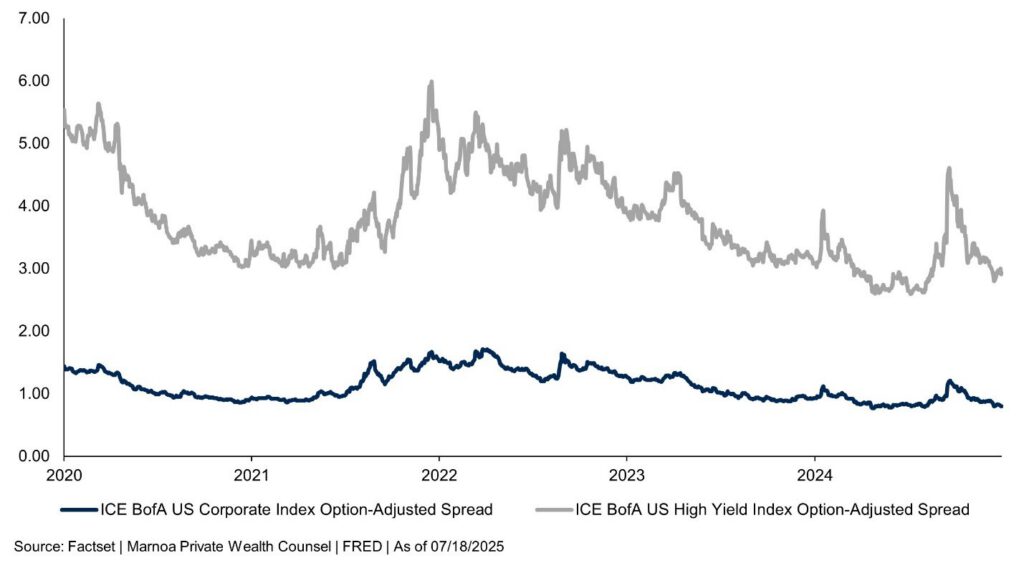
In H2 2025, we believe investors stand to benefit from allocating to bonds and fixed income, particularly those in retirement living on fixed income. While U.S. corporate bond spreads (the additional yield compensating investors for the higher risk compared to U.S. Treasuries) are below the five-year median, U.S. investment-grade corporate bonds still offer a reasonable yield premium across the yield curve. This is supported by resilient economic fundamentals, strong corporate earnings, and limited new bond issuance. In contrast, U.S. Treasuries face growing supply, particularly with the recent passage of the Big Beautiful Bill.
U.S. Investment Grade and High Yield Credit Spreads Offer Yield Pickup
Gold in the Sandbox, Oil on the Seesaw: Playing the Long Game
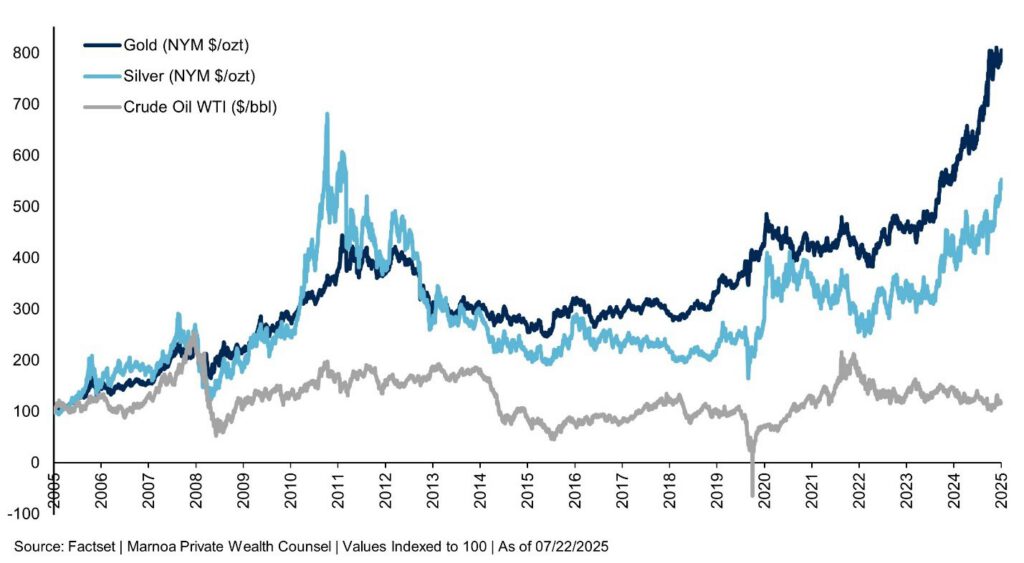
Precious metals, including gold and silver, remain well-supported in H2 2025, driven by persistent geopolitical tensions, uneven economic growth, and lingering inflation concerns. While near-term conflicts may trigger price volatility, the broader trend points to continued strength. In contrast, oil may see temporary price movements, but with supply and demand largely in equilibrium, the longer-term outlook suggests a more stable price environment.
Gold and Silver vs. Oil Price Performance (H1 2025)
Major Risks We Are Watching to Avoid a Playground Injury
The August 1, 2025, tariff deadline is a pivotal moment, like waiting for the seesaw to tip. Failure to secure trade agreements could trigger market declines, especially in sectors tied to U.S. markets, such as industrials and consumer goods. Geopolitical tensions and currency fluctuations also require vigilance. Our diversified approach aims to keep portfolios balanced.
Final Thoughts for Investors
The second half of 2025 will challenge investors to master the market playground. By focusing on regions and asset classes with strong fundamentals, diversifying globally, and remaining agile, we can transform volatility into opportunity. Like children laughing through the seesaw’s swings, our disciplined strategy—supported by data-driven insights—helps ensure our client portfolios are durable enough to withstand market turbulence.
At Marnoa Private Wealth Counsel, we, along with our research partners, remain laser-focused on the markets, making timely adjustments to help our clients achieve their long-term financial goals.
As always, feel free to reach out directly or share this note with friends and family. If you haven’t already, subscribe to receive regular updates like this directly in your inbox.
Sincerely,
Nadeem Kassam, CFA, MBA
Chief Investment Strategist, Chief Operating Officer and Portfolio Manager
Marnoa Private Wealth Counsel
Phone: 519-707-0048
Email: [email protected]
Website: marnoa.ca