MGM Resorts International (MGM) is a leading operator of gaming, hospitality, and entertainment resorts. MGM’s global portfolio consists of 30 hotels and casinos, including prized Las Vegas brands such as Bellagio, MGM Grand, The Mirage, Luxor, New York-New York, Excalibur, Park MGM, and Mandalay Bay. MGM is the largest resort operator on the Las Vegas Strip and services over 35% of the available hotel rooms in the market. MGM’S reach expands beyond Las Vegas, with regional hotels and casinos in New York, Michigan, New Jersey, Massachusetts, Ohio, Maryland, and Mississippi. MGM’s preeminent brand extends into Macau, the world’s largest gaming destination, where it operates the MGM Macau and MGM Cotai integrated resorts.
MGM owns 50% of BetMGM, the second-largest online sports betting and iGaming platform in the U.S. Entain PLC owns the other half. BetMGM presents an opportunity for MGM to connect with customers outside the walls of a casino floor. The omnichannel strategy of connecting customers across retail and digital channels will allow MGM to drive deeper engagement and loyalty to the MGM brand. BetMGM’s competitive advantage is the ability to leverage MGM’s destinations and M life Rewards loyalty program as a tool for customer acquisition. We believe BetMGM will drive expansion in MGM’s customer base and fuel growth in MGM’s hotels and casinos.
We continue to view MGM Resorts as a core holding in client portfolios.
Business Overview
In 2020, leisure hospitality and gaming operators reported big losses. Many hotel rooms were left unbooked. Lively casinos went dark. Las Vegas became a ghost town. MGM’s net revenues decreased by 60% to $5.6 billion or 40% of 2019 levels. In 2021, MGM is seeing an acceleration in revenue growth driven by pent-up leisure demand and casino spending. Revenue growth and cost savings have helped deliver EBITDAR (earnings before interest, taxes, depreciation, amortization, and rent) margins of over 30% at MGM’s Las Vegas Strip properties and regional casinos and exceed 2019 levels. Las Vegas Strip EBITDAR margins were 32.6% for the six months of 2021 (vs. 28.2% for all of 2019). Regional EBITDAR margins were 35.7% (vs. 27.3% for all of 2019).
In 2020, MGM fundamentally reevaluated how it operated. MGM focused on identifying and eliminating certain operating expenses, redundancies, and low profitability initiatives that were not essential to guest satisfaction or demand. As a result, MGM plans to reduce domestic operating expenses and achieve an annual run-rate of $450 million in cost savings. MGM appears well positioned to execute and deliver on these savings at Las Vegas and regional properties and drive meaningful EBITDAR margin upside when demand returns to 2019 levels. We believe the uplift in MGM’s near-term margins are sustainable and longer-term margins to be above 2019 levels. Overall, MGM will come out of the global pandemic much leaner and profitable.
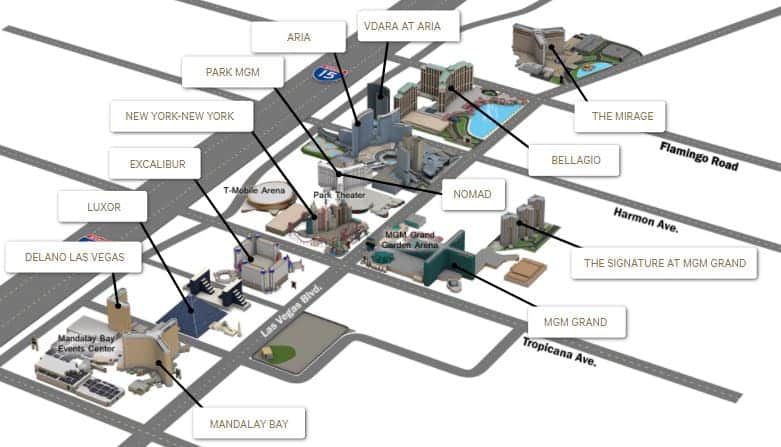
As a fly-to market, we expect MGM’s Las Vegas properties will take longer to recover as fly-to guests gradually return to air travel. In 2018, nearly half of the visitors to Las Vegas arrived by air travel of which 20% were international guests. A bright spot for MGM is the rebound in hotel occupancy, with weekend volumes recovering back to normal and average daily rates surpassing 2019 levels. In June and July, MGM’s Las Vegas Strip hotel occupancy was 83% and 86%, respectively, and outperforming the Strip’s averages. In addition, MGM currently has more room nights booked for 2022 than it did in 2019.
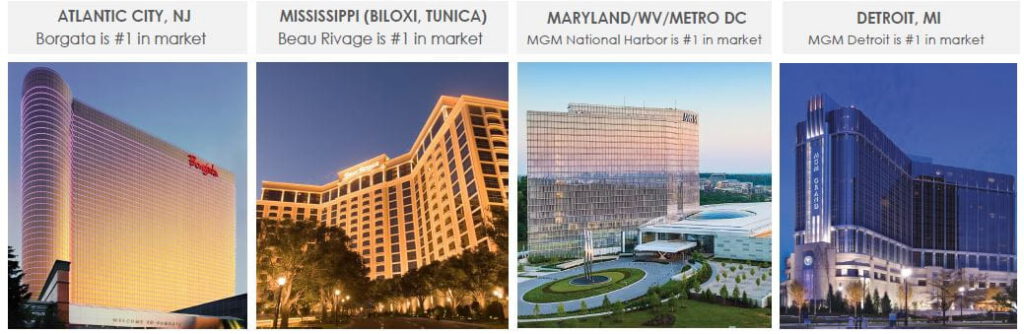
We expect hotel revenue per available room at MGM’s Las Vegas properties to increase with occupancy and average room rates improving, as well as capturing upside from the easing of capacity restrictions and pent-up leisure travel. MGM’s regional assets are performing at all-time record EBITDAR margins, with a number of properties generating record revenues. These are large integrated resort properties like those in Las Vegas. Many of them hold leading market share positions based on gross gaming revenues, such as Beau Rivage in Mississippi and Borgata in New Jersey. Since the regional properties are located in drive-to markets, they are naturally recovering much faster than hotels and casinos in fly-to markets.
Like the U.S. markets, we are seeing a steady recovery in Macau, China. MGM has a 56% stake in MGM China, which operates the MGM Macau and MGM Cotai hotel and casino resorts. MGM China holds a market share of 11.2%, where historically, market share stayed in the high single digits (2020: 9.9%; 2019: 9.5%; 2018: 7.9%). MGM China outperformed the market in the latest quarter, with gross gaming revenues recovering to 43% of pre-pandemic levels versus the broader market’s 35%. In 2020, MGM Macau hotel occupancy was 35.6%, down from 96.4%, whereas MGM Cotai was 22.4%, down from 91.6%. Hotel occupancy has improved to 83.5% and 51.9%, respectively, year-to-date. In our view, the secular growth story for the Macau market is being driven by the rise of Chinese wealth, consumption, middle-class population, and outbound tourism. In 2019, there were 28 million visitors to Macau from mainland China, which represented ~70% of all visits to the region. Therefore, MGM China is highly levered to the Chinese consumer spending and the rebound in Chinese outbound travel.
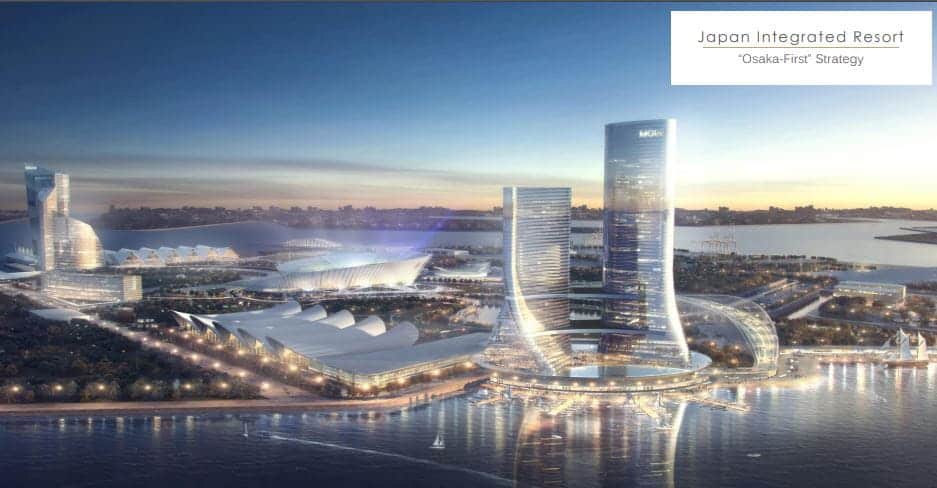
To expand further into Asia, MGM plans to develop a $9 billion integrated resort in Osaka following the legalization of casinos in Japan in 2018. MGM and Japanese financial-services partner Orix Corp. submitted a request-for-proposal last month as Osaka’s sole bidder to build the first casino in Japan. If approved, construction will likely start in 2023-24. We expect MGM’s portion of development costs to range from $2 billion to $2.5 billion spread over three years from 2024 to 2026. The integrated resort is estimated to attract 19 million visitors and generate $4.5 billion to $5 billion in annual gross gaming revenues—a healthy return on invested capital.
Long-term, Asia will become a larger contributor to revenue and profits. MGM expects Asia to represent half of total revenues over time, with approximately 30% to 35% coming from Las Vegas, and the balance from regional properties.
Online Gaming
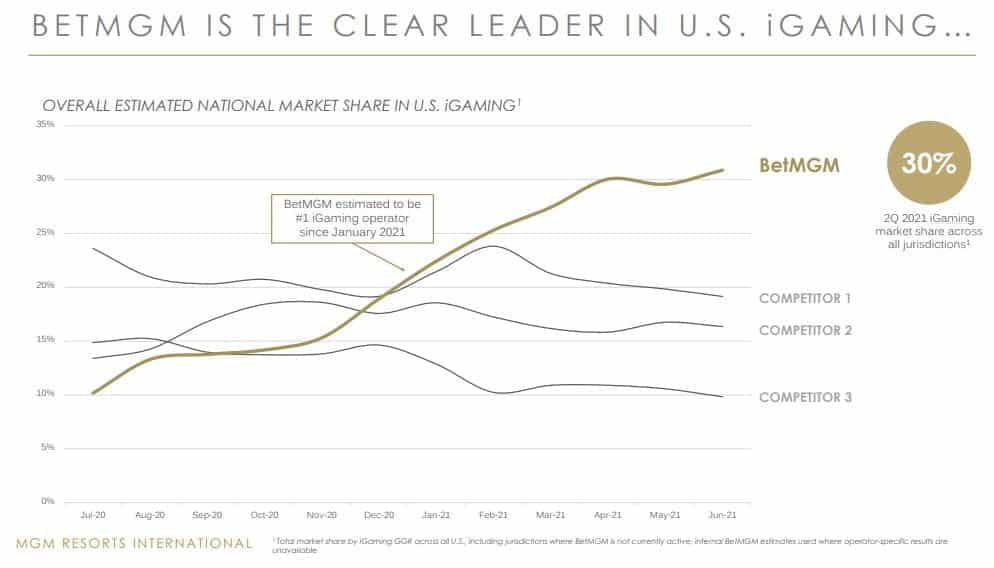
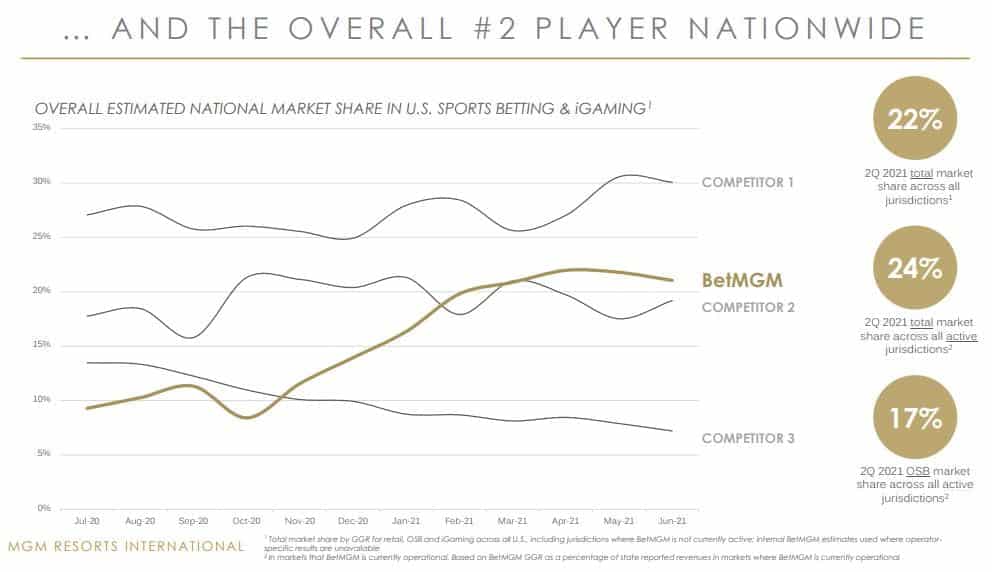
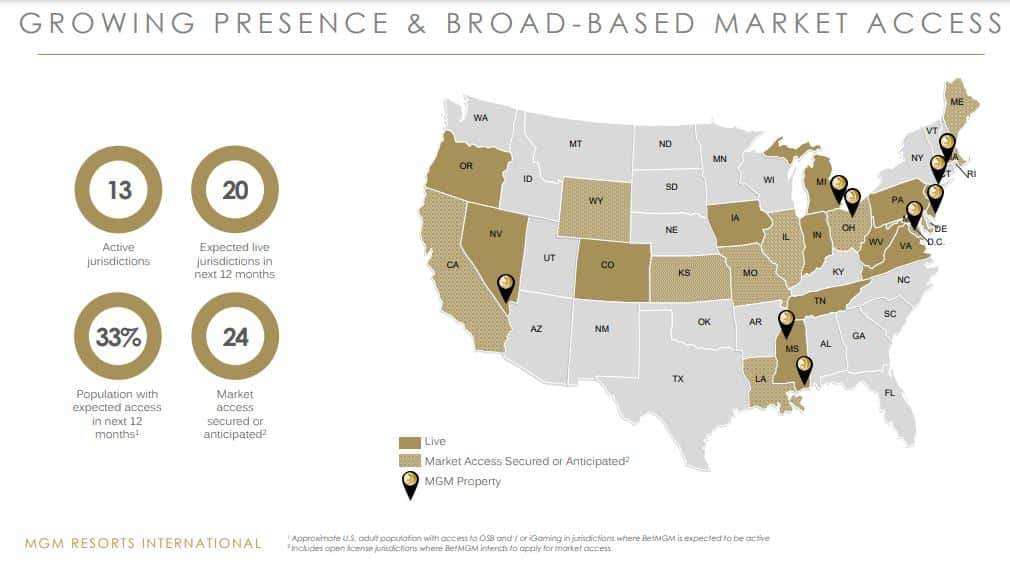
Expanding into Asia is only part of the growth plan. MGM owns a promising online gaming business called BetMGM that is expected to become a meaningful revenue and profit contributor longer term. BetMGM is the second-largest operator in the U.S. sports betting and online gaming market and holds 22% market share in all markets. Likewise, BetMGM holds 17% and 30% market share in online sports betting and iGaming, respectively. There is still a long way to go before the market reaches full maturity. Many states are still in the process of reviewing and issuing online gaming licenses. BetMGM is currently active in 13 states and plans to operate in 20 states by the second quarter of 2022. MGM expects BetMGM’s long-term U.S. market share to be 20% to 25%.
BetMGM is rapidly growing. Net revenue for the first half of this year was $357 million, which is double the amount of net revenue in all of 2020 ($178 million). MGM expects BetMGM to generate over $1 billion in net revenue in 2022 and to achieve profitability in 2023. Long-term, we’re looking at a business that will deliver steady-state EBITDA margins of 30% to 35%, with at least 20% share in a market that is worth $32 billion. To get there, it will require broader state adoption and market access, and the execution of an omnichannel strategy. Omnichannel refers to the integration of retail channels (land-based casinos and hotels) and digital channels (BetMGM). An omnichannel presence will help MGM deepen customer engagement, build up brand loyalty, and maximize the lifetime value of each customer.
The omnichannel customer, who plays in retail casinos, online sports betting, and iGaming, is more valuable than the single channel customer. In fact, customers spend 10 to 12 times more if they’re present in every channel. To further enhance customer engagement, BetMGM was integrated with MGM’s M life Rewards loyalty program that serves more than 36 million members. The average M life Rewards member visits Las Vegas three to five times a year, whereas the average customer visits only once a year. The integration is becoming an effective tool to cross-sell products and reducing customer acquisition costs (e.g., ~70% lower acquisition cost and marketing ROI i 5.4x higher for MGM sourced players). In the last year, 18% of new BetMGM customers came from the M life Rewards loyalty program, and 44% of new M life’s sign-ups came from BetMGM.
BetMGM customers earn points for every sports bet and online casino-style bet (e.g., slots, poker, baccarat, blackjack, craps, and roulette) that can be redeemable for real-life experiences, such as hotel accommodations, entertainment, and dining at MGM properties nationwide. About 18% of BetMGM customers visited an MGM property in 2020. When we look to competitors like DraftKings and FanDuel in the online betting category, we believe there is little differentiation in customer experience and lower switching costs associated with their products. In our view, the ability for a customer to play in a physical and digital capacity under one brand is a unique competitive advantage that will accrue to MGM’s benefit in winning market share.
Closing Remarks
MGM is a leading operator of premier hotel and casino brands in the U.S. and Macau. The global pandemic delivered a big blow to the hospitality and gaming industry. But we remain optimistic on the speed of the recovery because of the strong pent-up demand for leisure travel and gaming. On the digital side, we think BetMGM is a promising opportunity for the company. BetMGM is still relatively small compared to the company’s traditional casino business, but we expect it to be a meaningful contributor to revenue and profits long-term. Moreover, we believe today’s market valuation is ascribing little to no value to the online sports betting and online gaming assets. Lastly, we support MGM’s transition to an asset-light business model. This strategy has been widely adopted by hotel companies over the years. The hotel owner will sell the real estate but retain the right to operate the property on behalf of the current owner (e.g., sale-leaseback deals). An asset-light model enables MGM to unlock value from the real estate from asset sales and recycle the proceeds into high growth initiatives, like BetMGM and Japan. MGM has sold properties like the Bellagio, MGM Grand, and Mandalay Bay at premium valuations to become asset-light.
We continue to view MGM Resorts as a core holding in client portfolios.