As year-end approaches, it’s a great time to focus on capital gains planning—a key factor in improving after-tax investment returns. I know—taxes aren’t the most exciting topic. But here’s the thing: with the right strategies, you can keep more of what you earn.
Harvesting Losses and Timing Gains

Harvesting Losses
- Sell an investment for less than what you paid (the adjusted cost base or ACB) to realize a capital loss
- Losses can offset current-year gains
- If your losses exceed your gains, your net capital loss can be carried back three taxation years or carried forward indefinitely to offset future capital gains
Watch out for the superficial loss rule. If you sell an investment to realize a loss and then repurchase the same or identical investment within 30 days (either before or after the sale), the loss will be denied and added to the cost base of the repurchased investment. This rule applies to you and ‘Affiliated Persons,’ which includes:
- Your spouse or partner
- A corporation you or your spouse/partner control, or
- A trust where you or your spouse/partner are the main beneficiary (such as an RRSP or TFSA)
Strategic Gain Realization
Deferring gains isn’t always best. If you expect higher income—and tax rates—in the future, consider realizing gains now at a lower rate.
This Can Make Sense if:
- You’re in a career transition or taking time off work
- You’re in early retirement before pension income and mandatory RRIF withdrawals begin
- Your income varies significantly year to year
On death, all accrued gains are deemed realized (unless transferred to spouse/qualifying beneficiary), often at the highest marginal tax rate. By gradually realizing gains during your lifetime, especially in lower-income years, you can spread the tax burden over time at lower rates, preserving more wealth for your beneficiaries.
Don’t forget to factor the OAS Recovery Tax into your timing decision. For 2025, income above $93,454 triggers a 15% recovery tax; full OAS is eliminated at $151,668 (ages 65–74) or $157,490 (ages 75+).
Donating Appreciated Securities Directly to Charity

If you regularly support charitable causes, this strategy offers exceptional tax benefits. Instead of selling investments and donating cash, transfer securities “in-kind” to a registered charity.
Benefits:
- Tax receipt for fair market value (FMV)
- No capital gains tax on appreciated securities
Why This Works Well
- Ideal for investors with large unrealized gains in non-registered accounts
- Donation tax credits can be claimed up to 75% of net income in a year, with unused credits carried forward for up to five years
- For corporate donors, the benefits are even greater:
- The entire capital gain is tax-free
- 100% of the gain is added to the Capital Dividend Account, allowing tax-free dividends to shareholders
Example: John’s $50,000 Donation
John plans to donate $50,000 to his local hospital foundation. In the past, he would simply write a cheque. But because he’s in a high tax bracket, he’s considering a more efficient option—donating securities in-kind.
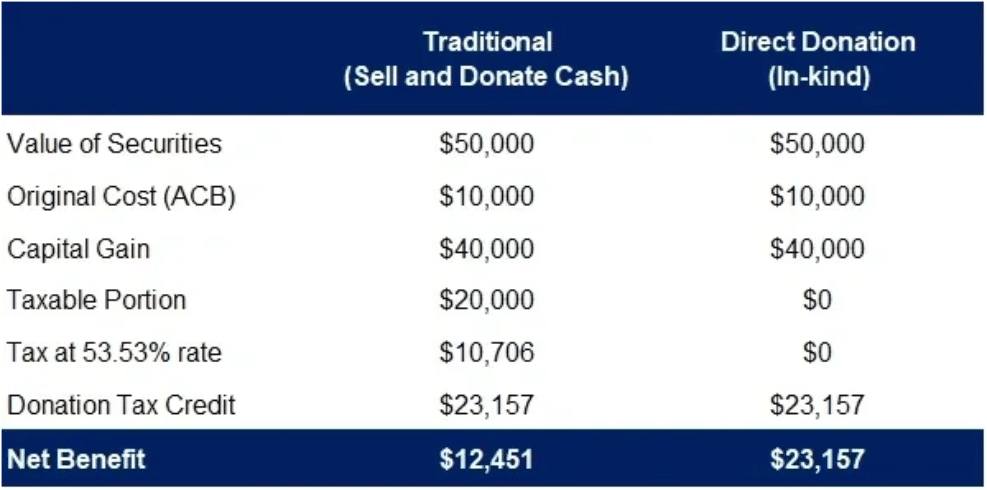
By donating securities in-kind, John avoids $10,706 in tax while the charity still receives the full $50,000. This is why donating securities directly is one of the most tax-efficient ways to give.
Our Role: As part of our ongoing service at Marnoa Private Wealth Counsel, we help identify which securities in your portfolio would be the best candidates for charitable donation when you’re planning your giving.
How We Bring It All Together

These strategies—loss harvesting, donating appreciated securities, and timing gains—work best in combination as part of a comprehensive financial plan.
Questions to consider:
- Do you have unrealized losses to offset gains?
- Could appreciated securities be donated directly?
- Does your income outlook create opportunities for strategic gain realization?
While tax planning is important, it should never override sound investment principles. Your portfolio’s primary job is supporting your long-term financial goals through appropriate growth and risk management. Tax efficiency enhances those returns but shouldn’t drive all decisions.
Ready to make your wealth work harder for you? Let’s explore strategies that are tailored to your goals – so you keep more of what you earn and give with impact.
Book a complementary consultation today.
Sincerely,
Tracy Andrade, CFP®, CIM®
Wealth Advisor and Financial Planner
Marnoa Private Wealth Counsel
Phone: 519-707-0050
Email: [email protected]
Website: www.marnoa.ca