To Our Valued Clients, Friends, and Family:
On April 2, President Donald J. Trump declared Liberation Day and unveiled a series of new tariffs that far exceeded expectations. While the move clarified the administration’s stance, it also introduced heightened uncertainty for businesses, investors, and global trade partners—repercussions that are likely to unfold in the coming days, weeks, months, and years ahead.
What’s New? The Tariff Shake-Up:
• Starting April 5: A 10% baseline tariff will be applied to all countries.
• Starting April 9: Countries labeled as the “worst offenders” will face steeper reciprocal tariffs. For example, China will face reciprocal tariffs of 34% on top of the existing 20% tariffs already in place.
Top 10 “Worst Offenders” – Countries Facing Reciprocal Tariffs > 10%
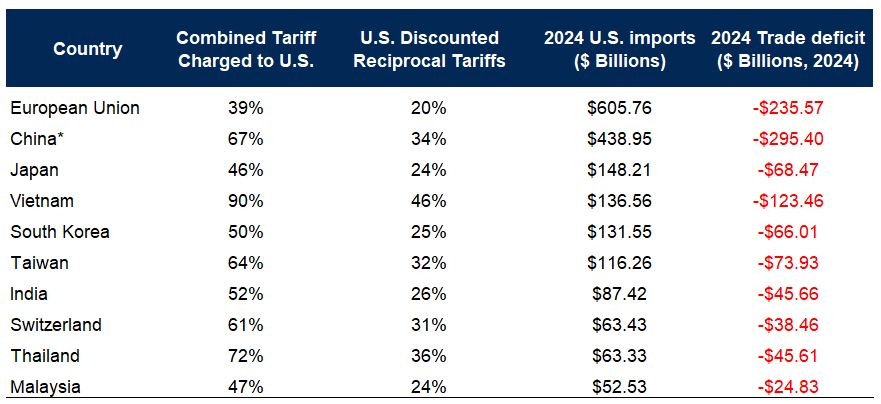
China’s 34% reciprocal rate is additional to the existing 20% tariff on all Chinese exports to the US
Sources: Marnoa Private Wealth Counsel, White House, US Census Bureau
The Days After Liberation Day…
Not surprisingly, these sweeping measures are sending shockwaves through global markets, introducing yet another layer of volatility. We anticipate that countries affected by these broad-based tariffs will respond with retaliatory actions—much like China did this morning by announcing a 34% tariff on all U.S. imports—and/or by reinforcing their own protectionist policies.
These developments are deeply concerning and mark a significant escalation in the ongoing trade conflict, pushing it into uncharted territory. That said, we remain cautiously optimistic that the severity of the tariffs announced on April 2 may ultimately serve as a catalyst—prompting renewed dialogue and encouraging a shift toward a more constructive and balanced tariff regime for all parties involved.
Crucially, these tariffs are being implemented under the International Emergency Economic Powers Act (IEEPA), following President Trump’s declaration of a national emergency to justify the move. As a result, the tariffs will remain in place until the administration determines that the perceived threat posed by the trade deficit has been sufficiently addressed—or until satisfactory progress is achieved with the targeted nations.
Penguins and Seals Caught in the Tariff Crossfire

Image via http://www.vinehousefarm.co.uk
Canada and Mexico: Safe or Not?
Thankfully, Canada and Mexico are exempt for now from the baseline tariffs (no reciprocal tariffs), but we can’t say the same for the uninhabited Heard and McDonald Islands near Antarctica, which were on the tariff list.
Jokes aside, the 25% tariffs which went into effect on March 4 on imported goods from Canada and Mexico, remain in place.
U.S.-Mexico-Canada Agreement (USMCA) goods will still be duty-free, but non-USMCA goods may face an additional 12% tariff. The auto import tariff from Canada will also rise in the coming days, but only modestly from 2.5% to approximately 3.5%.
What’s Exempt from Tariffs?
- Goods already subject to Section 232 tariffs—including steel, aluminum, autos, and auto parts—will not face reciprocal tariffs.
- Goods slated for Section 232 tariffs, like copper, pharmaceuticals, semiconductors, and lumber, are also safe from reciprocal tariffs.
- Additional exemptions include bullion, energy products, and minerals unavailable in the U.S.
What We’re Watching: Opportunities in Dislocated Markets
We see compelling opportunities where markets have overreacted to recent macro headlines—where, as the saying goes, the baby’s been thrown out with the bathwater.
- Global Equities: Selling pressure across certain equity sectors has been extreme—more so than during past market drawdowns. With tariffs mainly targeting durable goods, some sectors have been hit indiscriminately, creating value in oversold areas.
- Fixed Income: While fears of a trade-driven slowdown are weighing on bonds, tariffs are inherently inflationary. We’re watching for mispricing across the yield curve as markets struggle to balance growth risks with persistent inflation.
- Commodities & FX: Commodities and related equities are under pressure from both tariff concerns and growth downgrades. Inflation divergence—particularly between the U.S. and Canada/ROW—also presents tactical opportunities in FX markets.
Final Takeaway: Riding the Waves of Volatility
The uncertainty in global markets is palpable, and the likelihood of continued volatility is high. But remember, volatility is a natural part of investing. The key is to stay the course, stick to a long-term plan, and focus on quality investments with sound capital management.
Our strategy has delivered long-term value for clients, even through turbulent times, as we’ve remained proactive and opportunistic. By maintaining these principles, we are well-equipped to help you navigate uncertainty and stay on track for sustained financial success.
As always, please do not hesitate to reach out—we are always here to provide guidance and support. We are in this together.
Warm regards,
Pedro Ribeiro, CIM, FCSI
Founder, CEO and Portfolio Manager
Marnoa Private Wealth Counsel
[email protected]
519-707-0049
marnoa.ca